sites that use google maps
http://minstral.blogspot.com/2006/04/sites-that-use-google-maps.html
http://minstral.blogspot.com/2006/03/some-applications-of-google-maps.html
Positioning Software
http://minstral.blogspot.com/2006/03/positioning-software.html
Papers about wireless networks applications on social network services
http://minstral.blogspot.com/2006/03/papers-about-wireless-networks.html
WiFi/Cellular Roaming
http://minstral.blogspot.com/2006/03/wificellular-roaming.html
Saturday, September 9, 2006

Syllabus of Advanced Internet Applications 2006
About Professor YJ Chang and Applied Networking Lab
Grading Policy
Participation (Presence, Challenging and Answers, & Oral Presentations) 60%,
Homework 40%
Style
Our class is more of a conversation and dialogue than a lecture.
Textbook
1. Trends of Internet Applications and Business models
Trends of Networking
Beyond the Mobile Frontier by NTT DoCoMo
Blogging, Search Engine, Broadband Video, Peer to peer,
2. Search Engine
PageRank, Personalization
Business Models
3. Blogging
Blog vs. Web
Why Blog?
Things to learn with Blog
XML, RSS, Syndication
Blogging for Business Marketing
Blogging for Internal Communication
Blogging for Project Coordination, Basecamp
Blogging for Learning
4. Mobile Social Software
A List of Some Mobile Social Software
Tracking methods: Dodgeball and Navizon
Friends finding friends : Dodgeball.com
The Buddy Tracker in Navizon
繳交作業
文字式作業原則上使用 Blog: 請至 http://www.blogger.com 申請, 請以你的學號 (s/g開頭) 申請免費帳號。主旨欄請用格式 "作業一" 以加速助教登錄作業成績。
請將你的作業寫在你的 blog, 然後到
Homework 1 的Comment 登錄作業blog網址就可以了.
請勿將作業直接寫在 comment
注意事項
* 留言顯示驗證詞
* 正確設定時區顯示時間
* 測試他人可否留言(comment)
智慧財產
如果你的作業引用他人文章, 務必註明出處或是網址, 以示尊重他人創作.
研究建議
Scholar Google is one of the best tools for searching academic papers.
You can find a lot of good references in the areas that you feel interested.
簡報製作
如何做好一個簡報投影片, 請參看簡報製作原則
How to do research, by Tzi-cker Chiueh
同學對這門課的評語
update:
Grading Policy
Participation (Presence, Challenging and Answers, & Oral Presentations) 60%,
Homework 40%
Style
Our class is more of a conversation and dialogue than a lecture.
Textbook
- Jeremy Wright, Blog Marketing, McGraw Hill, 2006
- Y. J. Chang, Handouts of Advanced Internet Applications. Unpublished, 2006
- Social Capital and Information Technology
1. Trends of Internet Applications and Business models
Trends of Networking
Beyond the Mobile Frontier by NTT DoCoMo
Blogging, Search Engine, Broadband Video, Peer to peer,
2. Search Engine
PageRank, Personalization
Business Models
3. Blogging
Blog vs. Web
Why Blog?
Things to learn with Blog
XML, RSS, Syndication
Blogging for Business Marketing
Blogging for Internal Communication
Blogging for Project Coordination, Basecamp
Blogging for Learning
4. Mobile Social Software
A List of Some Mobile Social Software
Tracking methods: Dodgeball and Navizon
Friends finding friends : Dodgeball.com
The Buddy Tracker in Navizon
繳交作業
文字式作業原則上使用 Blog: 請至 http://www.blogger.com 申請, 請以你的學號 (s/g開頭) 申請免費帳號。主旨欄請用格式 "作業一" 以加速助教登錄作業成績。
請將你的作業寫在你的 blog, 然後到
Homework 1 的Comment 登錄作業blog網址就可以了.
請勿將作業直接寫在 comment
注意事項
* 留言顯示驗證詞
* 正確設定時區顯示時間
* 測試他人可否留言(comment)
智慧財產
如果你的作業引用他人文章, 務必註明出處或是網址, 以示尊重他人創作.
研究建議
Scholar Google is one of the best tools for searching academic papers.
You can find a lot of good references in the areas that you feel interested.
簡報製作
如何做好一個簡報投影片, 請參看簡報製作原則
How to do research, by Tzi-cker Chiueh
同學對這門課的評語
update:
- Yao-Jen Chang, Hsin-Yu Hsu, Frank Tsen-Yung Wang, Action Science Approach to Context Aware Personalized Housing Services using Web 2.0 Mapping Tools- A Nonprofit Case Implementation
- Yao-Jen Chang, Yao-Sheng Chang, Shu-Yu Hsu, Chiu-Hui Chen, Social Network Analysis to Blog-based Online Community, to be presented in International Conference on Convergence Information Technology 2007, Gyeongju, Korea. November 21~23, 2007. (EI)
- Yao-Jen Chang Hung-Huan Liu, Li-Der Chou, Yen-Wen Chen, Haw-Yun Shin, A General Architecture of Mobile Social Network Services, to be presented in International Conference on Convergence Information Technology 2007, Gyeongju, Korea. November 21~23, 2007. (EI)
- Yao-Jen Chang, Tseng-Yun Wang, Shi-Kai Tsai, Yu-Chia Chuang, "Action Science Approach to Experimenting Nonprofit Web 2.0 Services for Employment of Individuals with Mental Impairments" 2007 International Workshop on Social Media Analysis in conjunction with ACM/IEEE Web Intelligence 2007. (EI)
- Yao-Jen Chang, Tseng-Yun Wang, Sky Tsai, Yu-Chia Chuang "Nonprofit 2.0 Web Services- Case Study of Employment Services for Individuals with Mental Impairments" to be presented in IEEE TENCON 2007. (EI)
- Yao-Jen Chang and Chiu-Hui Chen, "Methodology and Evaluation of Teaching Computer Programming Laboratory with Social Media," ED-Media 2007, Vancouver, Canada, June 25-29, 2007.
Tuesday, September 5, 2006
Research Group at Applied Networking Lab
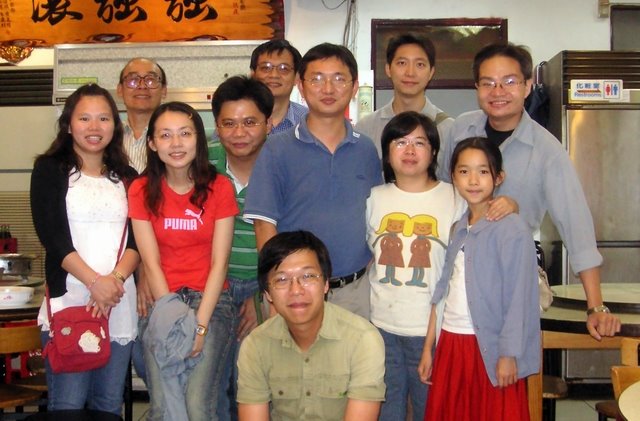
給研究生的話
研究生 ()為研究領域
碩專 2007 級
- Hanks (Bluetooth), 任職關鍵無線零件研發
- 志龍 (e-Government), 任職中科院
- 宋懷遠 (3G), 任職筆電研發
- 秋慧 (e-Learning) 任職高職電子科教師
- Jen, (Bluetooth) 任職藍芽關鍵零件研發
- 森翔 任職軍旅
2006 級
- 時定樑 (GPS),任職手機研發
- Fisher (Web 2.0)
- 善堯 (Car-to-Car)
2009 級
- 張萬志 (Task Prompting),任職網路設備研發
研一
大學部
Advices and Hints on doing research
1. "Advice on Research and Writing"
2. "How to Have a Bad Career in Research/Academia" by Dave Patterson,
3. How to do research in Experimental Computer Systems Lab, by Tzi-cker Chiueh
Saturday, August 26, 2006
How blogs are Changing the Way Teachers talk with their Students
One of the teaching challenges in computer-based laboratory is tracking student progress and giving assistance on an individual basis in the lab classroom. Designing specific systems to serve this purpose can be tedious and take great efforts. In addition, traditional web-based tools that help administer a course often store student works in a class-centric fashion. Once the class is closed, student materials may not be accessible to the students themselves any more.
Blogs have been used on campus for vastly diverse purposes. They are often seen as web publishing tools and social networking vehicles. Postings, tracebacks, and comments in the blog computing model usually happen without timelines in mind. Blogs interact with each other in a loosely coupled fashion as relations among blogs are usually nothing more than URL links or RSS subscriptions.
As a solution to the teaching challenge that the author has been wrestling with for years, blogs have been used in a novel fashion for three consecutive semesters at two hands-on computer lab classes, namely Java and Internet Applications, respectively. Our approach sees blogs from a more responsive point of view, and has them serve as catalysts for in-classroom student-instructor interactions.
First of all, the instructor creates a blog for the lab class at the outset. Every student of the class is required to create a blog for the lab when the semester begins. Instructor blogs are for posting lab materials in the curriculum and making announcements to the class. So they deliver lab sheets and hand-outs in electronic version. When finishing a lab, students are asked to submit their results at their own blogs and make a notice by placing a link at the instructor's blog right under the lab. Pursuing the links and checking out students' blogs, the instructor can grasp better immediate understanding of student progress such as how many have finished labs, how good the quality of the results is and what problems may have occurred. The blog is so responsive that instructors can make quick judgments on which students to walk by and initiate further interactions with. Through blogs, this can be done without students leaving their seats or even raising their hands, reducing interferences to others who may be still busy working on the lab. Reading the student blogs, the instructor has better chances to get better prepared before approaching them.
In this study, student feedback is collected and behavior patterns analyzed. Using blogs is found to simplify the tasks of reducing piracy. The tactics to prevent students from pirating in our study is by time stamping the lab works and making them public on the web as soon as possible. Blogs by design serve such a purpose. Anyone that pirates risks being caught by the instructor as well as virtually every other student in the class. We also have success with seeing students learning from peers through blogs. Traditionally, students turn in their works to instructors and have no easy way to learn how their peers achieve on the same assignments. By browsing the comments made by instructors on students’ blogs and the selected peer works, students have better chances to stimulate new ideas to be different from each other. The study shows students who took the lab courses are satisfied with turning in lab results through blog posting, getting instructor's walk-by interactions, piracy reduction, and learning from peers.
Keywords: Teaching with Technology, Blog.
Wednesday, August 16, 2006
國科會計畫: 結合無線定位技術之行動義工社會網路
社會網絡是由個別的人或專業群集間的關係連結而成,社會網絡也代表著這些連結的集合與彼此連結的強度。過去社會網絡研究通常在少許的參與者中進行,然而透過人手一機的手持裝置,加以位置資訊的應用,使得大範圍的社會網路研究可以實現。 應用此項技術於社會網絡上,求助者可以獲得及時且就近能夠提供幫助的人的位置資訊並請求協助。
結合資訊、電機、心理、社會福利政策、職能治療、管理等專業人才,本團隊致力於可應用在精神障礙者與成長遲緩兒之行動式關懷與非營利科技。近ㄧ年的努力,跨領域研究團隊於精障者就業輔導系統、認知障礙者導航、無線行動等技術已累積多項國際頂尖的研究成果,並於2007年獲得ACM SIGACESS 研究競賽獎項。本計劃網站請參閱計畫部落格。
相關聯結
媒體報導
學術著作
獲獎榮譽
服務學習
結合資訊、電機、心理、社會福利政策、職能治療、管理等專業人才,本團隊致力於可應用在精神障礙者與成長遲緩兒之行動式關懷與非營利科技。近ㄧ年的努力,跨領域研究團隊於精障者就業輔導系統、認知障礙者導航、無線行動等技術已累積多項國際頂尖的研究成果,並於2007年獲得ACM SIGACESS 研究競賽獎項。本計劃網站請參閱計畫部落格。
相關聯結
媒體報導
學術著作
獲獎榮譽
服務學習
Saturday, August 12, 2006
歡迎研究生使用 Applied Networking Lab
歡迎研究生使用 Lab 517, 目前空間仍多, 請多加利用.
另外最近剛剛加裝大噸位冷氣.
上網方式可分為有線與無線. 如使用有線, 目前 Lab 517 已經有
switching hub, 但須自行設定 IP.
如使用無線, 目前已經架設 EDIMAX 無線 AP, 速度為 54 Mbps,
因為內建 DHCP, 連線時無須設定電腦 IP, 即插即用.
Subscribe to:
Posts (Atom)
